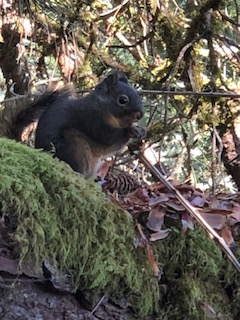
Over the past week I have hit and killed two squirrels as I drive the country roads on my way to work. Sometimes animals show up in my life, and their life energy speaks to something I am struggling with. I’m not saying these squirrels died for my sake, but that the experience was an opportunity to wake me up to how they live their lives, and to the lessons they may have to offer me:
“Squirrel has another lesson which can aid you if you observe the obvious, and which can prepare you for anything. It has to do with the safe place in which to put your gatherings. This safe place is an untroubled heart and mind, and that which is gathered to put in this place is wisdom and caring.
The energies gathered will set your heart and mind free, so that you will know that all will be taken care of in its own time. Apply this to your fears about the future and they will vanish.”
let birds sing me
let the sun shine me
let mud mud me
let leaves rustle me
let cedars perfume me
let vistas amaze me
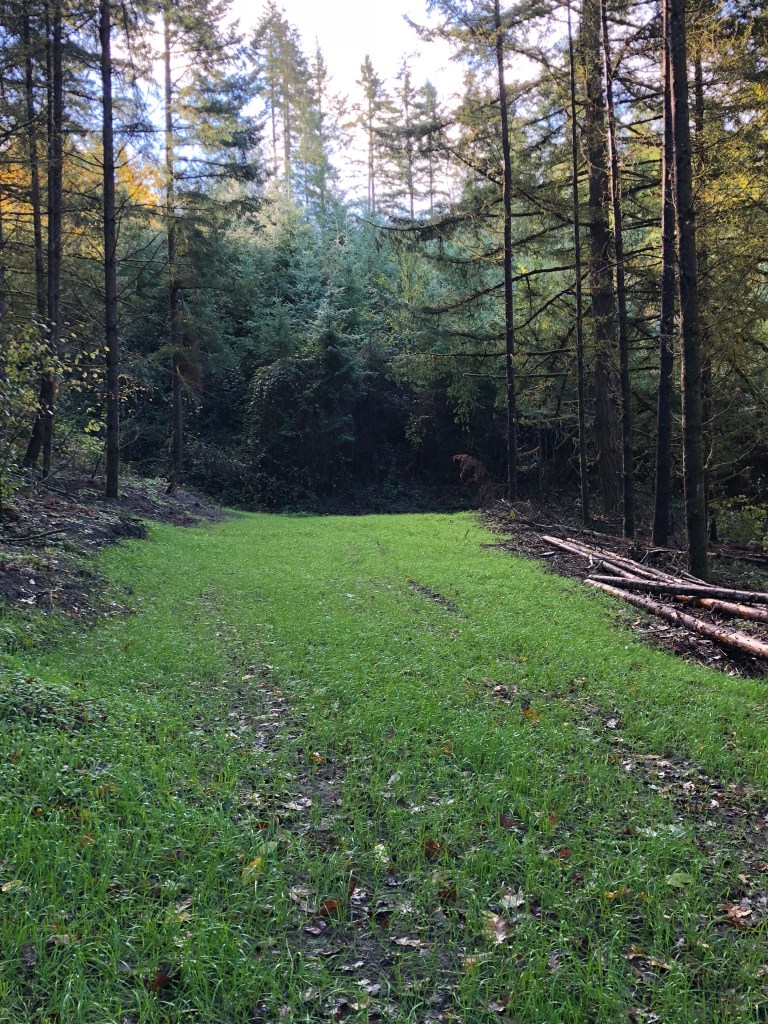
let a broad grassy path
open me wide
let gentle breezes
caress my face and arms
let footsteps touch shadows
let clouds carry
thoughts away
Last night, a dream
our spaceship crashes
They say everyone, everything was
destroyed
But the woman ship captain
is there
me and others
and some precious things–broken, everyday items in
a flat open box
do remain…
I wish I could remember
more
The captain was calm, self-assured,
not afraid…of the truth
something was not quite right
I wish I could remember
a soulmate of the Buddha
What are the Buddhas’
dreams for me?
Do I have enough
confidence and courage
to act sufficiently?
To carry them out?
Just to go forward?
As best I can?
With actions that remember the heart?
What precious thing
am I carrying?
What is good enough?
In Mahayana schools of Buddhism, a bodhisattva is a person who practices not only for their own transformation, but also to help relieve the suffering of all beings. Reciting the Bodhisattva Vows of Mahayana Zen Buddhism can help practitioners water their aspiration to cultivate a mind of love and continue their practice—even through difficulties. The following is Thay’s translation of the Bodhisattva Vows, reflecting the essence of Plum Village teachings:
The awakened way is unsurpassable; I vow to embody it.
However innumerable beings are, I vow to meet them with kindness and interest.
However inexhaustible the states of suffering are, I vow to touch them with patience and love.
However immeasurable the Dharmas are, I vow to explore them deeply.
However incomparable the mystery of interbeing, I vow to surrender to it freely.
The Therigatha are poems of the first Buddhist women, ordained women who were called “senior ones” due to their spiritual achievements and ability to help others with their suffering. Many of these women came to the Buddha grieving the loss of their husbands, parents or family members. And many of them came to the Buddha suffering from what some claim to be the most intimate and heart-wrenching grief of all, grief over the loss of their child or children. The Buddha, with kindness and compassion, pointed them in the direction of healing.
The following is such a poem. Ubbiri’s poem offers encouragement to all of us, that we can transform even the most intimate, intense suffering.
Ubbiri
spoken by the Buddha to her
Mother, you cry in the forest, “O Jiva,”
get hold of yourself, Ubbiri.
Eighty-four thousand daughters, all with that same name,
the ones that said they were “Life,”
all have been burnt in this cremation ground,
so which one of them are you grieving for?
Spoken by Ubbiri
He pulled out the arrow that was hard for me to see,
the one that I nourished in my heart,
he expelled the grief for a daughter,
the grief that had overwhelmed me.
Today the arrow is pulled out,
I am without hunger, completely free.
I go to the Buddha his dhamma, and his sangha for refuge,
I go to the Sage for refuge.
In the Plum Village tradition, we recite the Five Contemplations before we begin eating. On retreat or with friends, we practice eating joyfully together in silence for a period of time. This way we are present for the food, our friends, and the wonders of Mother Earth, without being carried away from the present moment by conversation.
At home, part of my morning routine is to recite my own version of the Five Contemplations before I eat. This particular version began germinating from an insight I experienced while on retreat in the winter of early 2017. As I ate, I viscerally felt the many forms of suffering experienced by each grain of oatmeal, each piece of bread, each and every bit of food I ate. During that retreat I vowed to act with more kindness and less violence in my thoughts, words and actions. I’m still working on that 😉 Over the next nine months of practicing with the Five Contemplations, I changed or added phrases to remind me of my aspiration. It keeps my practice fresh and alive. Here is my current version:
This food is a gift of the earth, the sky, numerous living beings, and much hard and loving work.
May I eat with mindfulness and gratitude so that I can see clearly into the suffering and sacrifice that brings this food to my plate today.
Taking care of my hungry ghosts*, I vow to recognize and transform harmful habit energies**, cultivate courage & well-being, and practice eating with moderation.
May I keep compassion alive by consuming in such a way that reduces the suffering of living beings, stops contributing to climate change, and heals and renews this precious planet.
I accept this food so that I may deepen spiritual friendships, build our Beloved Community, and nourish my aspiration of serving all beings.
*hungry ghosts have narrow throats and big stomachs, are always hungry and never satisfied *whatever is alive right now, like craving, worry, fear, pride, agitation, etc.
Your eyes are made of the six elements-
earth, water, fire, air,
space, consciousness.
They are made of these only,
but they are beautiful.
Should I make them mine?
Should I try to make them last for a long time?
Should I try to record them?
But I know that what I can record
would not be your true eyes.
Your voice is made of the six elements,
but it is truly lovely.
Should I try to make it mine?
Should I try to record it?
But I know that what I can hold onto or record
would not be your true voice.
What I get may only be a picture,
a magnetic tape,
a painting,
or a book.
Your smile is made of the six elements,
but it is truly wonderful.
Should I try to make it mine?
Should I try to make it last for a long time?
Should I try to own or record it?
But I know that what I can own or record
could not be your true smile.
It would only be some of the elements.
Your eyes are impermanent
Your eyes are not you.
Yes, I have been told,
and I have seen it,
yet they are still beautiful.
Just because they are impermanent,
they are all the more beautiful.
The things that do not last long
are the most beautiful things-
a shooting star, a firework.
Just because they are without a self,
they are all the more beautiful.
What does a self have to do with beautiful eyes?
I want to contemplate your beautiful eyes,
even if I know
that they do not last
even if I know
they do not have a self.
Your eyes are beautiful.
I am aware that they are impermanent.
But what is wrong with impermanence?
Without impermanence, could anything exist at all?
Your eyes are beautiful.
I am told that they are not you, they have no self.
But what is wrong with the nature of nonself?
With self, could anything be there at all?
So although your eyes are only made of the six elements,
although they are impermanent,
although they are not you,
they are still beautiful,
and I want to contemplate them.
I want to enjoy looking at them as long as they are available.
Knowing your eyes are impermanent,
I enjoy them without trying to make them last forever,
without trying to hold onto or record them
or make them mine.
Loving your eyes, I remain free.
Loving your eyes,
I learn to love them deeply.
I see the six elements which they are,
the six wonderful elements.
These elements are so beautiful.
And I learn to love them too.
There are so many things I love-
your eyes, the blue sky,
your voice, the birds in the trees,
your smile, and the butterflies on the flowers.
I learn each moment
to be a better lover.
I learn each moment to discover my true love.
Your eyes are beautiful.
So is your voice, your smile,
the sky,
the birds,
the butterflies.
I love them. I vow to protect them. Yes.
I know to love is to respect.
And reverence
is the nature of my love.
Yellow jackets. The forest was humming with them. The air vibrating, pulsating. A sign of summer.
Birds. In the spring and summer, the birdsong is alive in our neighborhood, and our back yard. We also have turkey vultures flying overhead and roosting in the tall fir tree beyond our deck–high above the Willamette River below. I knew turkey vultures feasted on dead animals, but wondered how they could ever consume the flesh of all the birds in my neighborhood dying throughout the summer and fall. For all the living birds, I rarely saw a dead one. What happened to all those birds when they died?
Recently I was at the Abbey for a personal day of mindfulness, spending most of the morning and late afternoon up in the woods on Abbey land. During my morning walk I came upon a small bird, obviously sick, almost dead. A slight shudder and fluff of its wings was all the movement it could manage. I put a bit of water on the ground near it, and offered a quiet prayer that it would be well and not suffer greatly.
When I walked past that bird in late afternoon, it was dead, lying on its side. This time, just a few hours after my morning walk, the bird was swarmed with yellow jackets. The hum around the bird was an amplification of the humming forest.
I used to think of yellow jackets as dangerous pests. I have been stung and bitten by them in the past. Earlier this summer I disturbed (kind of broke) a yellow jackets’ nest hidden in some dried leaves near the side of our house, and they were fierce in their protective attack. So I left them alone and have been watching them, rebuild their nest and continue their lives. They are quite industrious and not so dangerous as I had previously thought.
Then, watching the yellow jackets consuming the bird’s flesh, I realized that maybe it was yellow jackets that helped to take care of birds when they die. Suddenly, the humming in the forest took on a deeper meaning for me. The death of the bird was the continuation of the yellow jackets in the form of nourishment. And the forest was alive with the humming of yellow jackets. Birthing and dying–the forest was full of it.
The Buddha taught that this is because that is. This is not because that is not. When causes and conditions are sufficient, manifestation happens. When causes and conditions are not sufficient, manifestation ceases. The conditions of the seasons help to manifest new birds in the spring and summer. The manifestation of birds and insects helps the yellow jacket wasps to manifest. The Buddha called this interdependent co-arising. Thay has called it interbeing.
Something is not born from nothing, and when something dies it does not become nothing. Thay has taught that birth and death are only manifestation or non-manifestation. Everything exists in the ultimate dimension. Its manifestation in the historical (that is, physical material) dimension depends upon causes and conditions. Even the birth of understanding (in this case, mine) depends on causes and conditions 🤗


 The Therigatha are poems of the first Buddhist women, ordained women who were called “senior ones” due to their spiritual achievements and ability to help others with their suffering. Many of these women came to the Buddha grieving the loss of their husbands, parents or family members. And many of them came to the Buddha suffering from what some claim to be the most intimate and heart-wrenching grief of all, grief over the loss of their child or children. The Buddha, with kindness and compassion, pointed them in the direction of healing.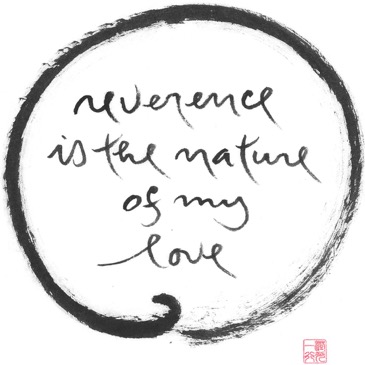
 nisi's corner