
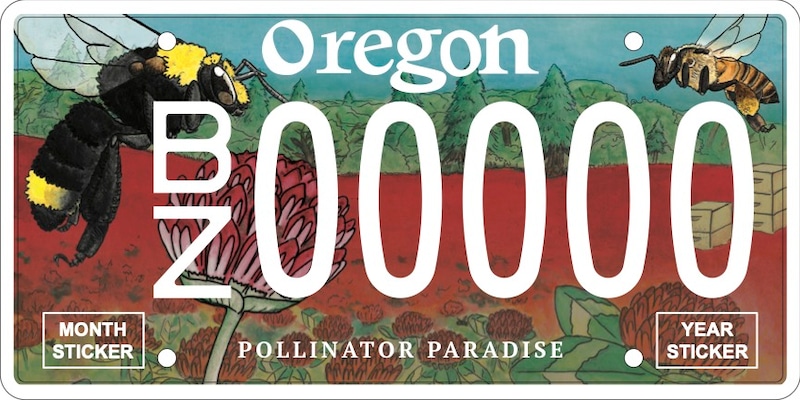
Featuring two of Oregon’s most iconic bees, the managed honey bee and the wild yellow-faced bumble bee, the new Oregon Pollinator Paradise License Plate is designed to showcase the unique Oregon landscape of natural areas, agricultural fields, and backyard gardens that help support the state’s over 600 species of bees. The plate design centers around a field of red clover – a majestic sight that can be found dotting the rolling hills of Oregon’s Willamette and Grande Ronde valleys.
Oregon produces over a quarter of the U.S. supply of red clover seed. Both managed and wild bees pollinate this crop. The nectar and pollen, in turn, is a key food source for bees.
This same interrelationship can be seen in every corner of the state, in coastal cranberry bogs, Rogue Valley pear orchards, high desert carrot seed fields, Columbia River Gorge sweet cherry orchards and Hermiston melon fields.
Bees and other pollinators around the globe pollinate trees, plants and crops which help make life possible on this earth. Without them humans and other species could not survive. But pollinator habitat is imperiled by the changing climate with it’s extremes in temperature, weather, flooding, fires, etc.
Just as pollinators are essential to life on this planet, kindness is essential to human, animal, plant, and planet well-being. Kindness is the essence of caring. And without caring, we don’t have the capacity to “take care of.” Yet, like the wild yellow-faced bumble bee flies around pollinating the flowers and crops, we can pollinate the world with our kindness and care. Without it, however, we face a world severely threatened by unchecked extremes of fear, hatred, violence, and indifference.
The Random Acts of Kindness Foundation offers all sorts of resources to make kindness a norm rather than an exception. According to Wikepedia, a random act of kindness is a non-premeditated, inconsistent action designed to offer kindness towards the outside world. Interesting to note: the phrase “random kindness and senseless acts of beauty” was written by Anne Herbert on a placemat in Sausalito, California in 1982.
Acts of kindness can be spontaneous, like bees moving from one flower to another. Kindness can also be cultivated through an intentional practice of opening our heart to whatever arises, and greeting it with acceptance and love. Then just letting go of whatever we are clinging to. From that place, kindness can spread like a soft breeze, blanketing everything with it’s touch. What might happen if each of us consciously practiced acts of kindness throughout our day and made it our default behavior as we interact with others?
The more kindness we experience for ourselves, the more kindness we can offer to others. We create a pollinator’s paradise with fields of kindness wherever we go.
 nisi's corner